10:30-12:16
|
Professor Sogliato and the Board
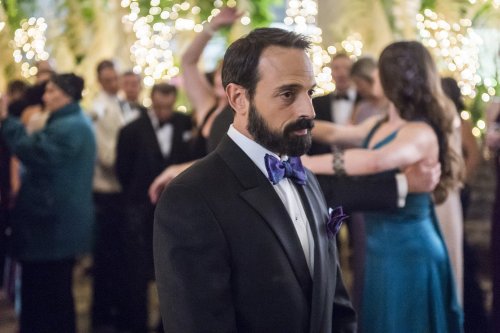
Sogliato: “Dr. Fell, I hope you translate as well as you waltz.”
Member: “Our new appointee was confirmed by the board after close questioning.”
Sogliato: “You’ve examined him in medieval Italian and I will not deny his language is...admirable...”
Hannibal: “Thank you.
Sogliato: “...for a straniero. Are you familiar with the personalities of pre-Renaissance Florence? I think not. Dr. Fell might hold in his hand - in his non-Italian hand - a note from Dante Alighieri himself. Would he recognize it? I think not.”
....
Hannibal: “Allegro mi sembrava Amor tenendo meo core in mano, e ne le braccia avea madonn involta in un drappo dormendo Poi la svegliava e d’esto core ardendo lei paventosa umilmente pascea; appreso gir lo ne vedea piangendo. Dante’s first sonnet. It fascinated Cavalcanti. The eating of the heart is a powerful image.”
Sogliato: “If he’s such an expert on Dante, let him lecture on Dante, to the Stu diolo. Let him face them. Extempore.”
Hannibal: “I’m happy to sing for my supper.”
|
Sogliato is revealed in Hannibal Chapter 19 to be envious of ‘Dr. Fell’’s new position as the curator due to desiring the position for his nephew.
From Hannibal, Chapter 19:
The nepotist, Sogliato, had the floor, and was holding it by dint of volume: "The Capponi correspondence goes back to the thirteenth century. Dr Fell might hold in his hand, in his non-Italian hand, a note from Dante Alighieri himself. Would he recognize it? I think not. You have examined him in medieval Italian, and I will not deny his language is admirable. For a straniero. But is he familiar with the personalities of pre-Renaissance Florence? I think not. What-if he came upon a note in the Capponi library from-from Guido de' Cavalcanti for instance? Would he recognize it? I think not. Would you care to address that, Dr Fell?"
…
"Cavalcanti replied publicly to Dante's first sonnet in La Vita Nuova, where Dante describes his strange dream of Beatrice Portinari," Dr Fell [Hannibal] said. "Perhaps Cavalcanti commented privately as well. If he wrote to a Capponi, it would be to Andrea, he was more literary than his brothers." Dr Fell turned to face the group in his own time, after an interval uncomfortable to everyone but him. "Do you know Dante's first sonnet, Professor Sogliato? Do you? It fascinated Cavalcanti and it's worth your time. In part it says:
"The first three hours of night were almost spent The time that every star shines down on us When Love appeared to me so suddenly That I still shudder at the memory. Joyous Love seemed to me, the while he held My heart within his hands, and in his arms My lady lay asleep wrapped in a veil. He woke her then and trembling and obedient She ate that burning heart out of his hand; Weeping I saw him then depart from me."
Listen to the way he makes an instrument of the Italian vernacular, what he called the vulgari eloquentia of the people:
"Allegro mi sembrava Amor tenendo Meo core in mano, a ne le braccia avea Madonna involta in un drappo dormendo. Poi la svegliava, a d'esto core ardendo Lei paventosa umilmente pascea Appreso gir to ne vedea piangendo."
Even the most contentious Florentines could not resist the verse of Dante ringing off these frescoed walls in Dr Fell’s clear Tuscan. First applause, and then by wet-eyed acclamation, the memberships affirmed Dr. Fell as master of the Palazzo Capponi, leaving Sogliato to fume. If the victory pleased the doctor, Pazzi could not tell, for he turned his back again. But Sogliato was not quite through. "If he is such an expert on Dante, let him lecture on Dante, to the Studiolo." Sogliato hissed the name as though it were the Inquisition. "Let him face them extempore, next Friday if he can."
|
32:28-34:20
|
The Studiolo
Hannibal: “In accord with my own taste for the pre-Renaissance, I present the case of Pietro della Vigna, whose treachery earned him a place in Dante’s Hell. He was disgraced and blinded for betraying his emperor’s trust. Dante’s pilgrim finds him in the seventh level of the Inferno, reserved for suicides. Like Judas Iscariot, he died by hanging. Judas and Pietro della Vigna are linked in Dante’s Inferno. Betrayal, hanging… then linked since antiquity, the image appearing again and again in art. This is the earliest known depiction of the Crucifixion, carved on an ivory box in Gaul about A.D. four hundred. It includes the death by hanging of Judas, his face upturned to the branch that suspends him. On the doors of the Benevento Cathedral, we see Judas hanging with his bowels falling out. And here, from a fifteenth-century edition of The Inferno is Pietro della Vigna’s body hanging from a bleeding tree. I won’t belabor the parallels with Judas Iscariot. Betrayal, hanging, self-destruction. ‘Io fei gibetto a me de le mie case.’ ‘I make my own home be my gallows.’ Mr. Dimmond. Welcome. Please join us. We were just about to discuss the matter of chewing in Dante.”
(applause)
Hannibal: “Thank you for your kind attention.”
|
In Hannibal, Chapter 36:
Much in accord with the Studiolo's taste for the pre-Renaissance, Dr Lecter began with the case of Pier della Vigna, Logothete of the Kingdom of Sicily, whose avarice earned him a place in Dante's Hell. For the first half-hour the doctor fascinated them with the real-life medieval intrigues behind della Vigna's fall. "Della Vigna was disgraced and blinded for his betrayal of the emperor's trust through his avarice," Dr Lecter said, approaching his principal topic. "Dame's pilgrim found him in the seventh level of the Inferno, reserved for suicides. Like Judas Iscariot, he died by hanging. "Judas and Pier della Vigna and Ahithophel, the ambitious counselor of Absalom, are linked in Dante by the avarice he saw in them and by their subsequent deaths by hanging. "Avarice and hanging are linked in the ancient and the medieval mind: St Jerome writes that Judas' very surname, Iscariot, means `money' or `price,' while Father Origen says Iscariot is derived from the Hebrew `from suffocation' and that his name means `Judas the Suffocated." ' Dr Lecter glanced up from his podium, looking over his spectacles at the door. "Ah, Commendator Pazzi, welcome. Since you are nearest to the door, would you be kind enough to dim the lights? You will be interested in this, Commendatore, as there are two Pazzis already in Dante's Inferno . . ." The professors of the Studiolo cackled dryly. "There is Camicion de' Pazzi, who murdered a kinsman, and he is expecting the arrival of a second Pazzi-but it's not you-it's Carlino, who will be placed even farther down in Hell for treachery and betrayal of the White Guelphs, the party of Dante himself." A little bat flew in through one of the open windows and circled the room over the heads of the professors for a few laps, a common event in Tuscany and ignored by everyone. Dr Lecter resumed his podium voice. "Avarice and hanging, then, linked since antiquity, the image appearing again and again in art." Dr Lecter pressed the switch in his palm and the projector came to life, throwing an image on the drop cloth covering the wall. In quick succession further images followed as he spoke: "Here is the earliest known depiction of the Crucifixion, carved on an ivory box in Gaul about A.D. four hundred. It includes the death by hanging of Judas, his face upturned to the branch that suspends him. And here on a reliquary casket of Milan, fourth century, and an ivory diptych of the ninth century, Judas hanging. He's still looking up." The little bat flickered across the screen, hunting bugs. "In this plate from the doors of the Benevento Cathedral, we see Judas hanging with his bowels falling out as St Luke, the physician, described him in the Acts of the Apostles. Here he hangs beset by Harpies, above him in the sky is the face of Cain-in-the-Moon; and here he's depicted by your own Giotto, again with pendant viscera. "And finally, here, from a fifteenth-century edition of the Inferno, is Pier della Vigna's body hanging from a bleeding tree. I will not belabor the obvious parallel with Judas Iscariot. "But Dante needed no drawn illustration: It is the genius of Dante Alighieri to make Pier della Vigna, now in Hell, speak in strained hisses and coughing sibilants as though he is hanging still. Listen to him as he tells of dragging, with the other damned, his own dead body to hang upon a thorn tree: "Surge in vermena a in pianta silvestra: VA rpie, pascendo poi de Ie sue foglie, fanno doloye, a al dolor fenestra." Dr Lector's normally white face flushes as he creates for the Studiolo the gargling, choking words of the agonal Pier della Vigna, and as he thumbs his remote control, the images of delta Vigna and Judas with his bowels out alternate on the large field of the hanging drop cloth. "Come l'altre verrem per nostre spoglie, ma non pero ch'alcuna son rivesta, the non a giusto aver cio ch'om si toglie. "Qui le strascineremo, a per la mesta selva saranno i nostri eorpi appesi, ciascuno al prun de l'ombra sua molests. "So Dante recalls, in sound, the death of Judas in the death of Pier delta Vigna for the same crimes of avarice and treachery. "Ahithophel, Judas, your own Pier delta Vigna. Avarice, hanging, selfdestruction, with avarice counting as self-destruction as much as hanging. And what does the anonymous Florentine suicide say in his torment at the end of the canto? "Io fez' gibetto a me de Ie mie case. "And I - I made my own house be my gallows. "On the next occasion you might like to discuss Dame's son Pietro. Incredibly, he was the only one of the early writers on the thirteenth canto who links Pier dells Vigna and Judas. I think, too, it would be interesting to take up the matter of chewing in Dante. Count Ugolino chewing on the back of the archbishop's head, Satan with his three faces chewing Judas, Brutus and Cassius, all betrayers like Pier delta Vigna. "Thank you for your kind attention." The scholars applauded him enthusiastically, in their soft and dusty way, and Dr Lector left the lights down as he said good-bye to them, each by name, holding books in his arms so he would not have to shake their hands. Going out of the soft light of the Salon of Lilies, they seemed to carry the spell of the lecture with them.
|